Anomaly Detection: Hidiroglou-Berthelot or HB-edit
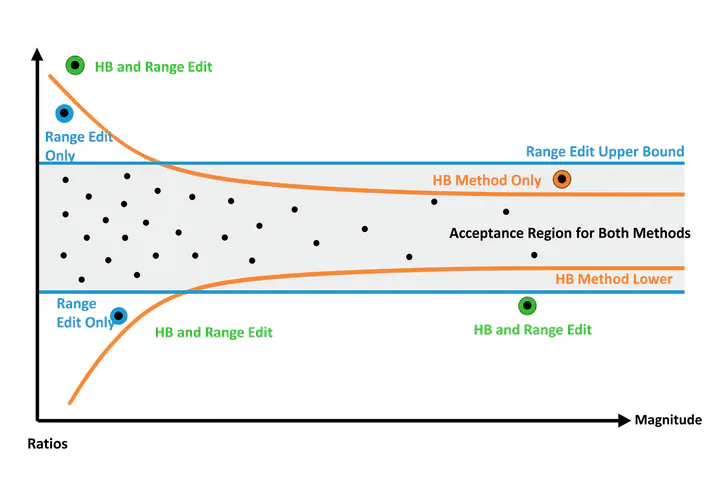
http://www.asasrms.org/Proceedings/y2023/files/HB_JSM_2023.pdf
https://ssc.ca/sites/default/files/survey/documents/SSC2003_R_Belcher.pdf
Background
The Hidiroglou‑Berthelot method, or HB‑edit, was introduced by Hidiroglou and Berthelot in 1986 to enhance outlier detection in periodic business surveys, particularly where units (e.g. companies, survey respondents) exhibit wide variations in size. Detecting outliers in survey data can be difficult due to the extreme variation in the size of respondents.
For each entity $i$, compute the ratio of its current value $x_i(t)$ to its previous value $x_i(t-1)$:
$$r_i = \frac{x_i(t)}{x_i(t-1)}$$Center these ratios around their median $r_{Q_2}$ or $r_{M}$ through a transformation generating $s_i$, which is symmetric around zero:
$$ s_i = \begin{cases} 1 - \frac{r_{Q_2}}{r_i}, & \text{if } 0 < r_i < r_{Q_2}, \\ \frac{r_i}{r_{Q_2}} - 1, & \text{if } r_i \geq r_{Q_2} \end{cases} $$
Then, to account for the size of the observation the HB method creates an effector vector, $e_k$, by scaling the symmetric ratios as followis:
Incorporate the size of the unit—by taking the maximum of $x_i(t)$ and $x_i(t-1)$, raised to the power of a tuning parameter $U$ (between 0 and 1)—to compute the effect score:
$$E_i = s_i \times \bigl[\max(x_i(t), x_i(t-1))\bigr]^U, \text{ where } 0 \le u \le 1$$- Larger units require smaller relative changes to be flagged as outliers.
- Smaller units tolerate proportionally larger fluctuations.
Define outlier boundaries based on percentiles or quartiles of the $E_i$ distribution. Typically:
$$[E_M - C \times d_{Q1},\; E_M + C \times d_{Q3}]$$where:
- $E_M$ is the median of $E_i$;
- $d_{Q1} = \max(E_M - E_{Q1}, |A \times E_M|)$;
- $d_{Q3} = \max(E_{Q3} - E_M, |A \times E_M|)$;
- $A$ is a small constant (commonly 0.05);
- $C$ scales how wide these bounds are (commonly 4–7).
Units whose $E_i$ fall outside this interval are flagged as outliers.
Why Is HB-edit Useful?
- Size-aware flexibility: By incorporating unit size via $U$, the method adjusts tolerance for change.
- Symmetric detection: Captures both unusually large and unusually small changes.
- Data-driven, nonparametric: No strong distributional assumptions.
- Adjustable sensitivity: Parameters $U$, $A$, and $C$ allow analysts to tune sensitivity.
Assumptions & Practical Considerations
Key assumptions and caveats:
- Ratio-of-change distribution should be smooth and roughly symmetric.
- Parameter tuning requires care—defaults are often $U = 0.4$, $A = 0.05$, $C = 4$–7.
- Many identical ratios can cause quartile issues—percentiles (e.g. 10th & 90th) may work better.
- HB-edit is univariate; multivariate anomaly detection requires different methods.
Practical workflow:
- Plot the distribution of $E_i$ scores.
- Experiment with parameter values.
- Use adjusted boxplots or other robust diagnostics.
- Always review flagged outliers in context.
Summary Table: HB-edit Snapshot
| Element | Description |
|---|---|
| Ratio $r_i$ | Change between periods |
| Centered $s_i$ | Symmetric score around median |
| Effect $E_i$ | Size-weighted score |
| Parameters | $U, A, C$ for tuning |
| Bounds | Median-based, robust intervals |
| Use Cases | Surveys, census, business data |
| Strengths | Size-aware, symmetric, flexible |
| Limitations | Needs tuning, univariate only |
Final Thoughts
The Hidiroglou-Berthelot (HB-edit) method is a robust and interpretable tool for outlier detection—especially well-suited for longitudinal survey or administrative data where units vary widely in size. With careful parameter tuning and visualization, HB-edit highlights meaningful anomalies without overwhelming analysts with false positives.
Demonstration
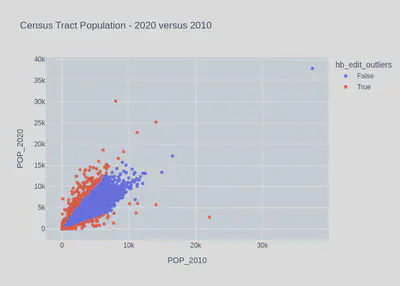
To demonstrate this method I am going to use the 2020 and 2010 Census tract-level population estimates. Code to create this dataset from the Census API is available here:
Click to view code
import requests
import pandas as pd
from tqdm import tqdm

state_fips = [f"{i:02d}" for i in range(1, 57) if i not in {3, 7, 14, 43, 52}]

def fetch_tracts(year, var, base):
    """
    Fetch tract-level totals for all states for a given year.
    year: 2010 or 2020 (only used for clarity)
    var:  'P001001' (2010) or 'P1_001N' (2020)
    base: 'https://api.census.gov/data/2010/dec/sf1' or 'https://api.census.gov/data/2020/dec/pl'
    """
    frames = []
    states = [f"{i:02d}" for i in range(1, 57) if i not in {3, 7, 14, 43, 52}]

    for st in tqdm(states, desc=f"Downloading {year} tracts"):
        # Example:
        # .../data/2020/dec/pl?get=NAME,P1_001N&for=tract:*&in=state:01&in=county:*
        url = f"{base}?get=NAME,{var}&for=tract:*&in=state:{st}&in=county:*"
        response = requests.get(url, timeout=120)
        response.raise_for_status()
        data = response.json()
        df = pd.DataFrame(data[1:], columns=data[0])
        # Ensure numeric population
        df[var] = pd.to_numeric(df[var], errors="coerce")
        frames.append(df)

    if not frames:
        return pd.DataFrame(columns=["NAME", var, "state", "county", "tract"])

    out = pd.concat(frames, ignore_index=True)
    return out

# -------- fetch --------
# 2010 Decennial SF1, total population P001001
df10_raw = fetch_tracts(
    year=2010,
    var="P001001",
    base="https://api.census.gov/data/2010/dec/sf1"
)

# 2020 PL 94-171, total population P1_001N
df20_raw = fetch_tracts(
    year=2020,
    var="P1_001N",
    base="https://api.census.gov/data/2020/dec/pl"
)

# -------- tidy + merge --------
df10 = df10_raw.rename(columns={"P001001": "POP_2010"})
df20 = df20_raw.rename(columns={"P1_001N": "POP_2020"})

# Keep consistent keys
keep_cols = ["NAME", "state", "county", "tract"]
df10 = df10[keep_cols + ["POP_2010"]]
df20 = df20[keep_cols + ["POP_2020"]]

# Merge on tract FIPS (state+county+tract) and NAME
tracts = df10.merge(df20, on=["state", "county", "tract", "NAME"], how="outer")

# Optional: build a full 11-digit tract GEOID (2 state + 3 county + 6 tract)
tracts["GEOID"] = tracts["state"].str.zfill(2) + tracts["county"].str.zfill(3) + tracts["tract"].str.zfill(6)

# Reorder columns nicely
tracts = tracts[["GEOID", "NAME", "state", "county", "tract", "POP_2010", "POP_2020"]]
import numpy as np

def hidiroglou_berthelot_outliers(y_k, x_k, u = 0.5, a = 0.05, c = 4, quantile_lo = 0.25, quantile_hi = 0.75, verbose = False):
    """
    Hidiroglou-Berthelot Method (...) for Outliers.

    Assume numerator and denominator are same length.

    Parameters
    ----------
    y_k : 1D data
        Data to test.
    x_k : 1D data
        Data to test.
    u : float
        Parameter. Controls curve of final boundaries. Commonly (u = 0.50)
    a : float
        Parameter. Ensures upper and ower bounds are not arbitrarily close to the median. (a = 0.05)
    c : float
        Parameter. Controls the width of the acceptance region. (c = 4)
    quantlie_lo : float
        Parameter. Optional quantile for lower bound of effects vector. Usually 25th percentile, but could be 10th.
    quantlie_lo : float
        Parameter. Optional quantile for lower bound of effects vector. Usually 75th percentile, but could be 90th.

    Returns
    -------
    outliers : ndarray of bool, shape (n,)
        Boolean mask indicating which points in `data` are considered outliers.
        True for detected outliers, False otherwise (including NaNs).

    References
    ----------
    Hidiroglou, M.A., and Berthelot, J.-M. (1986). ”Statistical Editing and Imputation for Periodic Business Surveys”. Survey Methodology, 12, 73-83.
    """
    y_k = np.array(y_k)
    x_k = np.array(x_k)

    # Check length
    if y_k.shape[0] != x_k.shape[0]:
        raise ValueError(f"y_k and x_k must be the same length. Got lengths: {len(y_k)} and {len(x_k)}")

    # Ignore NaNs and zeros
    valid = (x_k != 0) & (y_k != 0) & ~np.isnan(x_k) & ~np.isnan(y_k)

    # Ratio
    r_k = y_k[valid] / x_k[valid]

    # Ratio Median
    r_Q2 = np.quantile(r_k, 0.50)

    # Centering transformation
    s_k = np.where(
        (r_k < r_Q2) & (r_k > 0),
        1 - (r_Q2 / r_k), # 0 < r_k < r_Q2
        (r_k / r_Q2) - 1  # Otherwise
    )

    # Effects vector
    e_k = s_k * np.maximum(x_k[valid], y_k[valid])**u

    e_Q1 = np.quantile(e_k, quantile_lo)
    e_Q2 = np.quantile(e_k, 0.50)
    e_Q3 = np.quantile(e_k, quantile_hi)

    # Upper and Lower HB Bounds
    bound_lo = e_Q2 - c * max(e_Q2 - e_Q1, a * np.abs(e_Q2))
    bound_hi = e_Q2 + c * max(e_Q3 - e_Q2, a * np.abs(e_Q2))

    # Masks effects vectors as outliers
    outlier_effects = (e_k < bound_lo) | (e_k > bound_hi)

    # Creates mask like original length of data
    outliers = np.full_like(x_k, False, dtype = bool)
    outliers[valid] = outlier_effects
    return outliers
import plotly.express as px
from IPython.display import Image, display
import pandas as pd

df = pd.read_csv("census_tract_population_2010_2020.csv").dropna()
df = df[(df["POP_2010"] > 0) & (df["POP_2020"] > 0)]

df["hb_edit_outliers"] = hidiroglou_berthelot_outliers(
    df["POP_2020"],
    df["POP_2010"],
    u = 0.5, a = 0.05, c = 10, quantile_lo = 0.1, quantile_hi = 0.9
)
fig = px.scatter(
    df,
    x = "POP_2010",
    y = "POP_2020",
    color = "hb_edit_outliers",
    title = "Census Tract Population - 2020 versus 2010"
)
fig.write_image('fig1.png')
#display(Image(filename="fig1.png"))
#fig.show()
References
- Hidiroglou, M.A., and Berthelot, J.-M. (1986). ”Statistical Editing and Imputation for Periodic Business Surveys”. Survey Methodology, 12, 73-83.